Take the arcade apart

Scroll down. This is the mini arcade we built to show that you can 3D print the sensor, not just the box around it.

200 × 200 × 320 mm

A small arcade with a big excuse

A trade-fair demonstrator for 3D-printed sensors, printed entirely in Recreus filament, with their support.

Everything else first

The joystick leaves in one piece

The cabinet comes apart. The joystick module lifts out whole: screws, sensor membrane, handle, flexure, cup and circuit board.

Half a turn

The joystick module

Everything that senses and moves is in here. Most of it is printed TPU, in different hardnesses, each with its own job.

The handle

The button is printed too

Look at the tip of the red trigger.

Two printed tracks

Inside the handle

Two tracks in Conductive Filaflex run inside the handle and end here, at the tip.

Closing the circuit

A trigger that bends

A conductive piece on the red trigger touches both tracks. A cylindrical cut behind the trigger lets it bend instead of hinging, so there is no hinge to wear out.

Seen through

Printed in, not added on

With the handle made see-through, the tracks show where they run. The whole button is printed.

The sensor

A red membrane in Filaflex 70A

The softest material in the joystick, so the membrane can move.Want to build one yourself? The membrane is Filaflex 70A and the tracks are Conductive Filaflex, both from Recreus. Nice people.

The whole circuit is printed

Conductive Filaflex, printed into it

Everything black on the membrane is Conductive Filaflex.

Conductors

Carrying the signal

The thick zigzags, the pads under the handle and the rings round every screw. The zigzag lets them stretch and shrink without pulling on the material itself, so their resistance barely changes as the membrane moves.

Voltage divider

Printed too

On each arm, three pads join a fixed and a variable resistor. That is a voltage divider, and it is printed.

Fixed resistors

The short zigzags at the edge

Half of each divider: printed resistors that stay put.

Variable resistors

Where the signal comes from

The other half: the thin lines on each arm. Move the stick and they stretch, so their resistance changes.

Four arms

One per direction

X+, X−, Y+ and Y−.

The presser

Hard, but not too hard

Under the membrane, a part in Filaflex 95A presses on it when the stick moves. It is the hardest TPU here, but still TPU: if someone plays rough, it bends before the membrane suffers.

The flexure

A joint that bends

Inside the presser, a small flexure, also in Filaflex 95A, works as the ball joint. 3D printing is not good at parts that slide over each other. Parts designed to bend do better, and Filaflex 95A is great at it.

The board

What reads the stick

An ESP32-S3 Super Mini reads the sensors. The game runs on a Raspberry Pi 5 behind the screen.

Done

Back in one piece

Open source
Yes. The assembly guide is out; the CAD files follow after Formnext.
Team
Mine, with help from researchers at LITecS, who will have a bigger hand in the paper on the sensor itself.
My part
The idea, the design and the build.
Materials
All Recreus filament. The blue is PET-G HF in Damantium. Inside: Conductive Filaflex, Filaflex 70A and Filaflex 95A. Recreus supported the build.
Patent
The earlier joystick that started it all: Portuguese patent application 120023, published August 2026.

Why an arcade

A printed sensor is hard to explain on a poster. An arcade is not: people walk up, grab the stick and play. By the time they ask how it works, they have already tested it.

One family of materials, four jobs

Most of the joystick is printed in flexible filaments from Recreus, and each hardness does something different. Conductive Filaflex senses and carries the signal. Filaflex 70A, the softest, lets the membrane move. Filaflex 95A, the hardest, is structural but can still bend, so nothing breaks when someone plays rough. And the flexure moves by bending, not sliding, because 3D printing is good at parts that bend and bad at parts that slide over each other.
Play with one at Formnext

From 17 to 20 November 2026 the arcade is at the Recreus stand, at Formnext in Frankfurt: Hall 12.1, Stand F59. Grab the stick. Playing rough is allowed; that is what the Filaflex 95A is for.

Build your own

The assembly guide covers printing, heat-set inserts, wiring, the Raspberry Pi and calibration. Download the assembly guide PDF, 2 MB

The CAD files will be available soon, after Formnext.

One email when it is out. Your address is used for nothing else and deleted afterwards.

The paper

We are writing a scientific paper on the printed joystick sensor.

One email when it is out. Your address is used for nothing else and deleted afterwards.

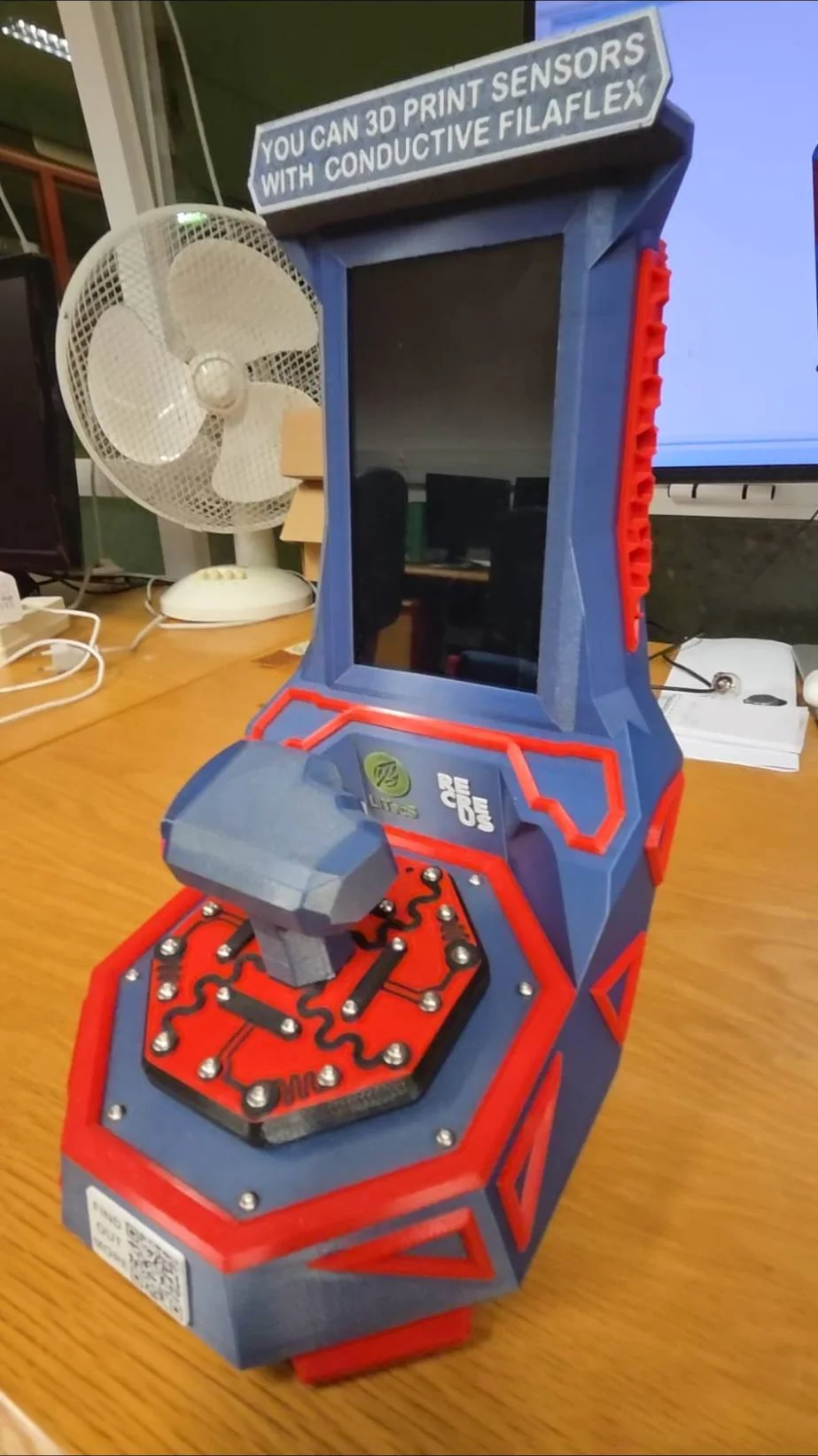
The printed mini arcade on a desk: blue and red body, red joystick membrane with black printed tracks, Find out more QR sticker
The real one, before it went to Recreus.

More on printed sensors: our Formnext 2024 talk (video).

Back to all work