How it started
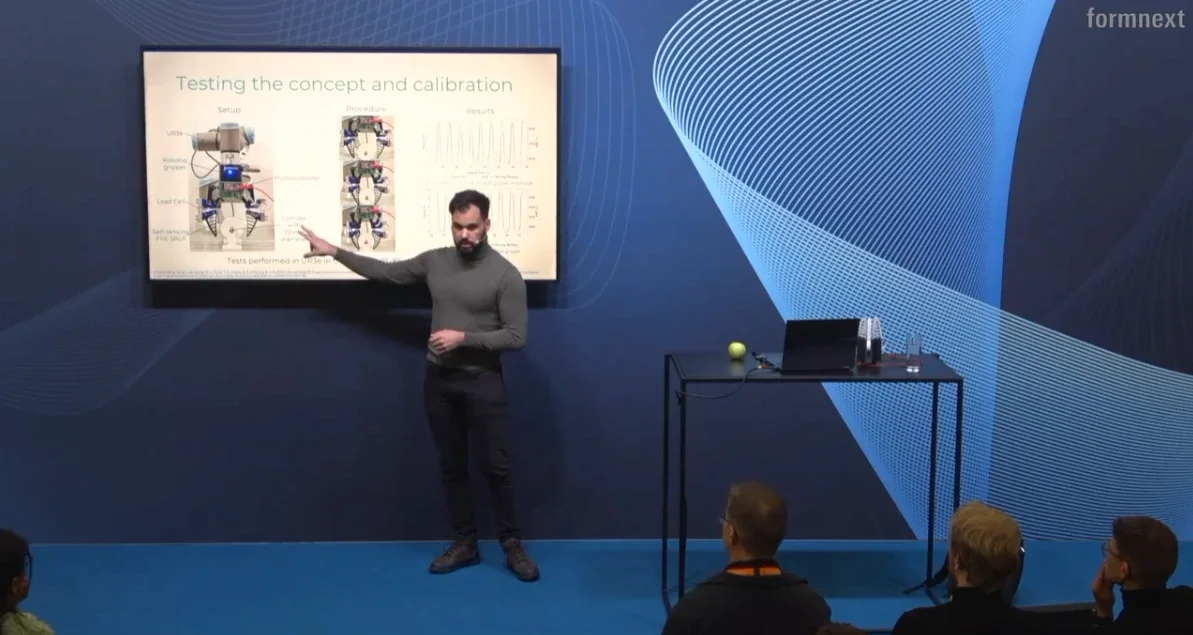
In ROBOTA-SUDOE we were working on soft grippers based on the Fin Ray effect. Separately, we were exploring printed circuits with a conductive flexible filament. We built a circuit, and the LED did not light up. When we measured the resistance, it would not settle on a value.
The material was not only conductive, it was piezoresistive: its resistance changes when it deforms. We were already making flexible fingers. So: what if the finger measured its own deformation?
The problem it solves
Fruit is hard for robots. It bruises easily, which soft grippers already deal with. But it also comes in every size, and a gripper that cannot feel has to guess. SensiFlex feels the grasp, and that signal is used to control it.
The sensor is not glued to the surface of the finger. It is embedded in it during a multi-material print, conductive and non-conductive material in the same job. That gives us the freedom to design the sensor however we want, with more sensitivity exactly where we want to feel.
Made to measure
Every mechanism was designed for additive manufacturing: minimal supports, the simplest print that works. Grippers are not mass-produced, and that is the point. The same gripper can be scaled up for melons or down for strawberries. A tool we are developing already sizes the finger for the product, and will size the actuator next.
The result is a gripper matched to the arm and the task: not too heavy for a small arm doing delicate work, not too weak for bigger jobs.
Where it is now
It began with ROBOTA-SUDOE funding and now continues inside LITecS on its own funding and a few awards. One PhD thesis is on simulating and designing the fingers for each application; another explores new finger architectures.